Sunday, December 8, 2013
5 contemporary artists... says Tate Britain
apparently the choice was random... 5 contemporary artists...at Tate Britain. There was absolutely no recollection of the Venice Biennale earlier this year. Clearly, these 5 british artists are not avante garde in the european sense. In fact there was very little distinct or unique about these pieces of work. I only really appreciated two of the five; Tomma Abts and Gillian Carnegie, but sadly I learned very little about either... but then, not sure if I was meant to!
unmoved by Art Under Attack at Tate Britain
The renovated front entrance to the Tate Britain opens up a new and open friends room under the dome, and a stylish marble spiral staircase. It was fun to create new geographical connections and I was keen to visit the new exhibition, Art under Attack, which aimed to describe the history of British iconoclasm, through three main themes of religion, politics and aesthetics. There was quite an effort to define iconoclasm, as image breaking, but also conversely meaning innovation.
It was difficult to interpret the dissolution of the monasteries as innovative, rather than the egotistical machinations of a crazy king. The children of King Henry VIII were variously catholic and protestant and sought to impose their new found laws as religious leaders.
Therefore, it seemed inevitable that they would abuse their new and misunderstood power.
While I detest the wilful destruction of art, I wonder where to draw the line between art that is propoganda, in the form of educational paintings and political statues, and art that conveys an accessible artistic message. When the message is no longer important, is destruction of art just another form of clearing out?
Further, what exactly is vandalism? In the streets of Berlin and other edgy cities, it has been described as art, but when it interacts directly with traditional art, that is not so acceptable. But then, so little of current art is in any way interactive, that it seems inevitable that tensions will overheat. While the concept offered so much, the actual exhibition seemed a little bland and conservative, representing the current status quo of repaired materpieces with photocopies of patterns of dissatisfaction.
Sunday, December 1, 2013
inspired and impressed by Paul Klee at Tate Modern
We begin with the quote "Art does not reproduce the visible; rather it makes visible...and so begins the journey tracing the life and art of a truly gifted man. Paul Klee was born in December 1879 near Bern, in Switzerland and was an accomplished violinist before becoming an artist, teacher and writer. He lived through a tumultous time in German art and history, which has surely influenced his life and art.
He joined the expressionist 'Der Blaue Reiter' group near Munich in 1911. Here he was influenced by the bright colours and move towards abstraction of Wasily Kandinsky, Franz Marc and Gabriele Muenter. I remember visiting the Yellow house and Museum in Murnau, in the beutiful lakeland hills south of Munich.Such a pity this idyll was dismantled at the start of the first world war.Ten years later, he joins the teaching staff at the Bauhaus in Weimar, relocates the school to Dessau in 1925 and eventually resigns in 1931.
He is named as one of the degenerate artists by the Nazis and moves back to his native Switzerland, where he dies early from a degenerative disease in 1940.
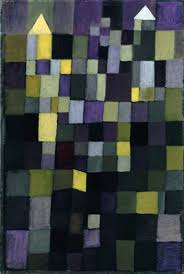
This history merely provides a backdrop of world events which also mirror some amazing changes in his creative strategies and work.
It seems that he was pre-occupied with lines, squares and colour gradations from the beginning. It is not clear whether his ability to teach influenced the logic and repetitive rigour of his work.
What is clear is his creative experimentation with styles and techniques. He loved texture and experimented with mixed methods in so many ways. He demonstrated the magic of the square, and interspersed them with rectangles, triangles and other shapes, in simple and complex tonal patterns, with impressive effects. I am particularly fascinated by his oil transfer technique where he traces over a wet oiled paper for a stunning effect.
He also uses small motifs to create patterns and stories. It feels like some of his pictures are visual dairies, and then I realised that he did actually write and reflect on his work. He seemed to be able to mix the logic of design and colour with the spontaneity of abstraction and surrealism in a visually balanced and aesthetically pleasurable manner. I felt that he was able to connect art and science in his work, and wonder whether being a teacher helped him to make that more transparent for others. I especially loved his quote "where intuition is is combined with exact research, it speeds up the progress of research".
The current retrospective exhibition at Tate Modern is brilliantly curated, across 17 rooms, with works from public and private collections across the world. It is both moving and educative. I had trouble choosing one favourite, as I would have liked one form each room, or genre of his painting.
Sunday, November 17, 2013
Space fantasy comes to life in Gravity
Every now and then we need a little escape from our own realities. While I have never harboured a passion to be an astronaut, I was curious about the recent space thriller, which brings science fiction into reality, almost... So I convinced my movie buddy to visit one of those expensive automated theatres without volume control, too many slick adverts and trailers of films I would never pay to see. Eventually we donned our 3D glasses for our very own trip out there. Interesting to note that the concept described by the title Gravity, is almost entirely absent. However the visuals of earth in shimmering blue contrast to the bulky astronaut suits and floating leggo space stations are impressive. Movement and speed are severely distorted as Sandra Bullock and George Cooney go weightless, swooping in slow motion while tethered together. Then it all goes so terribly wrong; falling and twisting sequences are sped up to reflect the seriousness of the situation and the real threat of flying debris. Time slows down again when she makes it back into the space station and we enjoy seeing and almost feeling the range of floating objects amidst the high tech screens and controls everywhere. The technical skills and wizardry almost take you there, as at times I felt my muscles tensing to reorient myself to the moving upright position!
So I guess it is inevitable that the technical prowess has won over the script, which is pretty thin; a disillusioned Dr Ryan Stone (Sandra) needs to escape her earth life after her daughter's death and is tentatively saved by the congenial space veteran Matt Kowalski(George). Throughout, we are wondering whether she will and can choose to save her life and return to earth! Allusions of this film as a religious parable, an ecological script or a feminist triumph are a bit too out there. But it was a seriously engaging and entertaining visit to a world away from mine - that left me happy to return!
Sunday, November 3, 2013
Surprised by Philomena
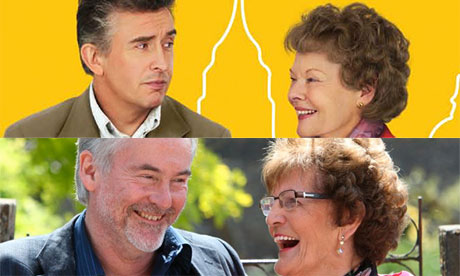
This was not just another remake of the tragic Irish story, but a brilliant exploration of the raw feelings between a mother and her son, as mirrored by a disillusioned journalist caught in a mere common interest story. Steven Coogan explained to Andrew Marr this morning that he wanted to move through cynicism, past sentimentality towards sincerity and authenticity. Yes he was moved by reading the true story, and he gave himself the lead role because this was his chance to portray an alternative to the comedic Alpha Papa series.
The script was authentic and it prompted independent thought and discussion about why the noble catholic church would sell illegitimate babies for cash at the same time as ignoring the mothers' feelings in the haze of punishment and penitance for carnal sins. It was easy to relate to Martin Sixsmith's anger, as a lapsed catholic. What was more challenging was to accept that Philomena was truly happy to receive confirmation that her son had considered her and that was sufficient to enable her to forgive such potentially damaging untruths. I personally could not believe that the nuns were so capable of blatant lies in the face of human suffering, but then perhaps theirs is not a normal life!
I was further incensed when I read more about Martin Sixsmith's journalistic challenge. It transpires that her son, the American Michael Hess was also tormented by his past and had visited the orphanage, to be turned away twice. I had under-estimated the real tragedy of both mother and son being unaware that they were trying to find each other, against the cruel manipulative lies of the church. How many other mothers and orphans have hidden similar stories of lost identities? A victory for human greed over spiritual compassion...
All the while, Dame Judi Dench played the Irish mother with humour and integrity. Steve responded with a dry wit, announcing that he “now knows what a lifetime of reading romance novels, the Reader’s Digest and the Daily Mail can do to the human brain”. Together, they transformed this dire story into one of compassion and hope. Truly inspirational entertainment...
Saturday, November 2, 2013
Flesh and Bone in Oxford
The Ashmolean Museum in Oxford has achieved national recognition for its exhibition titled Flesh and Bone, which contrasts the sculpture and drawings of Henry Moore with the paintaings of Francis Bacon.
Both lived through two wars and were intimately involved with them - but while Moore produced some amazing drawings of people sleeping in cortorted shapes in the bunkers and later transformed these into amazing sculptures, Bacon distorted solitary figures in large almost invisible cages. Despite similar abstract shapes, I was able to acknowledge a deep empathy in Moore's painting and to a lesser extent his sculptures, I only felt displaced anger in Bacon's grotesque paintings.
Perhaps there is a link to contrasting childhoods, where Moore was a loved child, growing up in southern England, and Bacon was a child in a harsh and critical family in Ireland. However, they are linked by their shared fascination with the human figure. For both men, art was about bones; ribs, forearms and eye sockets; and the contrast with surrounding flesh.
Vermeer and Music
It is not every Friday night that I can relax to a documentary about an art exhibition that I did not see. The National Gallery, in London, had a major exhibition of 30 paintings surviving from the mid 1600's by Johannes Vermeer, painter of the Girl with a Pearl Earring. Vermeer painted a lot of women with musical instruments, so it was good to find out more about these instruments and what life might have been like at the time.
The film was bigger than the exhibition and offered many insights into Vermeer's life. I really enjoyed listening to Tracy Chevalier, the author who created the story around the girl with a pearl earring.
Subscribe to:
Posts (Atom)