Wednesday, March 5, 2014

Hope vs challenge in The Book Thief

I had heard friends and critics rave about this film when it opened in Brisbane in January. The book, written by Markus Zusak, as a tribute to his German mother and Austrian father is an international bestseller, having been translated into 40 languages. Yet the cinema was almost empty in its first week in Oxford as the local UK critics canned this film. Why? ignorance, politics or bad timing??? anyway, its their loss... This is a moving and multi-layered film. It is uniquely introduced by death himself, who seems to live above the clouds. As Leisl is adopted for money into a childless Bavarian family, there is clear tension between the stern mother Rosa, played by Emily Watson and her new dad Hans, played by Geoffrey Rush, who gently eases her into the harsh family life. It quickly becomes apparent that Leisl has stolen a book from the gravediggers at her brother's funeral, in order to learn to read. Hans makes this task fun and her new love of words is reinforced by her delicate brotherly relationship with the family's hidden jewish boy, Max. It is more complex and dynamic than just a different version of Anne Frank or just another Nazi drama! Because Liesl has faced the early death of her brother, she is prepared to take massive risks for life and somehow she shares this with the young Aryan Rudy, who is an ardent admirer and a loyal friend. As she learns to read, she uses literature as an escape from the daily challenges of war. Of course this movie cannot have a happy ending, but there is a sense of enduring hope that is genuinely regenerative.

Sunday, March 2, 2014

Richard Deacon at Tate Britain

In this great short video, sculptor Richard Deacon says ‘I don’t carve, I don’t model. I fabricate'. As a result, his work is mesmerising; firstly I was caught by his design - was it symmetrical or just well balanced; then there was colour, contrasts, texture...and finally as I approached and walked around each piece I became absorbed by how he could ever have created it!
At a distance his wooden creations capture movement in a real and grounded way, but up close, the wood is twisted and curved in ways that are almost impossible. The more I looked at each piece the more I saw contrasts between form and space, light and dark, curves and angles and in the juxtaposition of wood and metal. I loved the curves of layered and laminated wood, woven stainless steel, curvaceous terracotta, bolted aluminium and glazed angular shapes, and I felt a deep satisfaction of something complete and integral. The pieces were so large and well displayed in the Tate Britain space, that I felt uplifted and energised by this amazing exhibition.

Richard Hamilton at Tate Modern

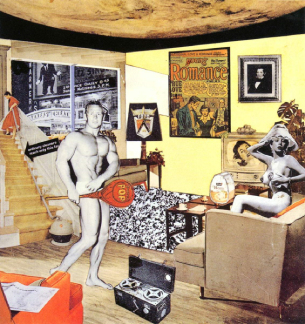
I could not miss this retrospective of almost 70 years, by the father of pop art, Richard Hamilton. It was good to see that Tate already owned quite a few pieces, and their curation and audioguide were definitely educational. I found out later, that he was born in 1922 in Pimlico to a not particularly artistic family. His drawing skills were noted early but it seemed that he also had a strong eye for science, mathematics and design.
In defining Pop Art as: popular, transient, expendable, low-cost, mass-produced, young, witty, sexy, gimmicky, glamorous, and Big Business, he emphasised the importance of everyday post-war consumerism. Rather than focus on single products like Andy Warhol did, he used collage to mix and match in fairly random ways - both in 2 and 3 dimensions. Later he seemed to experiment with completing and saving several versions of his key themes. He also started working with photography and it seemed that the message became more important than the medium. His work adopted a political tone and he was critical of Thatcherism, IRA prisoners, Tony Blair's war decisions, the sweeping control of Israel and the search for the perfect nude. Overall, this was a very comprehensive exhibition of a very capable artist whose interest in architecture and design includes objects as diverse as the Guggenheim Museum in New York and a classic Braun toaster.

Friday, February 28, 2014

The Betrayal... superb but shocking

As a sequel to The Siege, Helen Dunmore writes a stand alone novel, set 10 years after the Leningrad siege. Hopes are high that Anna, her brother Kolya and husband Andrei can rebuild their lives, by keeping quietly diligent and out of sight of Stalin's secret service. However Andrei, as a hardworking junior paediatrican, is not-so-innocently referred a young child who has a serious illness, by one of his senior colleagues. When he realises that he is a son of a senior secret policeman, Andrei believs that his medical duty is most important, and the fact that he quickly develops rapport with the young boy has enormous consequences. This is another meticulously researched historical novel, which describes the 1950's Soviet bureaucracy and hospital life, from the perspective of good people trying to do the right thing in challenging times. I was alternately mesmerised by the daily unravelling and shocked by Stalin's Russia, and ultimately thankful that I could be an avid observer.

Wednesday, February 26, 2014

impressive resilience in 12 years a slave

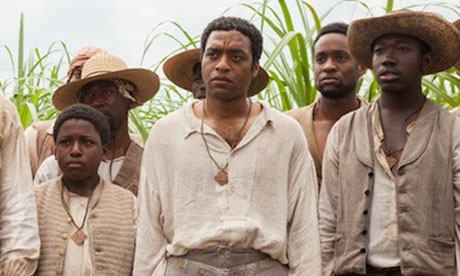
I was so impressed at the humility of Chiwetel Ejiofor when he received the BAFTA best leading actor award for playing Solomon Northup, and also when Steve McQueen accepted the BAFTA award for Best Film. It appeared that there was a reverence for the true story written down by Solomon over 150 years ago. So I braced myself for an important cinema experience... I can't say it was a comfortable 133 minutes, but the sheer brutality was mostly realistic and was somehow balanced by the brilliant visuals and sound track. Steve McQueen's artistic background was obvious and there were many stunning sunset panoramas of forests, rivers and plantations, contrasted by a distorted close up of a violin being tuned. It was a wonderful reflective escape from the dire reality. We initially meet Solomon as a devoted father and husband, living free in New York. He is lured by a two-week job as a musician, but is drugged and sold into slavery. He is renamed Platt and although he is horrified by his change in fortune, he quickly realises that he needs to manage his agression and retain some dignity. We are exposed to twelve years of violent racism and I was truly shocked at how self-righteous, pathetic and ugly the slave owners and their plastic wives were. So I was totally relieved when he met Brad Pitt, in the form of a Canadian abolitionist, who acted to change his life.

Wednesday, February 19, 2014

Invisible Woman..slow but dramatic

I am really enjoying historical drama at the moment - and the chance to see Ralph Fiennes direct and play Charles Dickens seducing a young muse was too much to resist. This was a slow and delicate costume drama, carefully depicting beautiful English country and seaside in the late 1880's. Felicity Jone plays Nelly the invisible woman, who, as the youngest and least accomplished of three actress sisters, was almost recommended for this affair, by her mother Kristin Scott Thomas. While I was surprised by this maternal protection of her daughter, I was totally bemused by Nelly's patronising need for marriage - it seemed as if the PC police had influenced the moral tone for the current generation... Anyway the creative egoistic male is not a new concept, and it is reassuring to see the English recognise one of their own. And Ralph played Charles so enticingly...

Sunday, February 16, 2014

amazing impressions of a mountaineering artist - Gabriel Loppe

it was a snowy afternoon treat - to find in the Musee Alpin in Chamonix, a mountaineering artist; Gabriel Loppe.
For someone painting in the mid 1800's, he was an early impressionist who was truly able to capture to delicate light on snow and ice at altitude. Way before photos, he must have entranced those who could only dream of heading up into the mountains. For those of us lucky to have been up there, he captures both the light and the emotions of wonder at the physical power and beauty of rugged mountain peaks and ridges. I was spellbound by the way he captured the different colours and layers of glacial ice. This exhibition aimed to celebrate the 100 year anniversary of his death, and was arranged in different rooms to reflect themes of alpine nature, sunsets, snow filled valleys, snow scenes and finally, his studio. I was able to imagine a wealthy adventurer, traveller and aesthete. From his home in Geneva, he climbed Mont Blanc three times in 1861, and regularly visited Chamonix, Zermatt, Paris and London.