Sunday, November 2, 2014

Discovering Tutankhamun...in Oxford

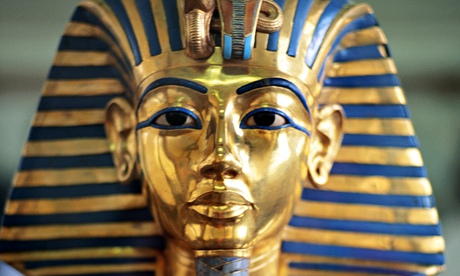
The Ashmolean's summer exhibition, Discovering Tutankhamun, recounts the story in 1922 of finding the tomb of this Eqyptian boy-king. Lord Carnarvon and Howard Carter led the excavation of the tomb of Tutankhamun and painstakingly began to document every object in the 4 hidden rooms. The exhibition begins with Carter's diary open at the page where, in November 1922, he recorded finding the stone steps leading down to the door of a royal tomb with its seals still intact. When he broke through a second door, and used a candle to illuminate the underground caverns, he reported seeing many "wonderful things". While we can only see drawings and some very old photographs of masks, beads, carriages and painted boxes, of originals which will never leave Cairo, there is a sense of the enormity of his find. Although Tutankhamun only ruled for 4 years, died in his late teenage years and never had children with his step-sister wife, there is a sense that this find gave him an international reputation that is larger than it could have been at the time of his death...

Poppies surround the Tower of London

This is one of the most impressive displays of public art I have seen in London. This progressive installation, titled Blood Swept Lands and Seas of Red, marks the centenary of the outbreak of the First World War. Exactly 888,246 ceramic poppies have been hand made by artist Paul Cummins, to represent soldiers who lost their life, and have progressively filled the Tower of London’s moat. It was great to see the crowds of people out to see this spectacle, without entry fee. It was also fun to hear parents telling thier children of the significance of each poppy. And it was amazing to see the enormity of this vision...wow...

Sigmar Polke: linking the Tate Modern with New York and Nazi Germany

Art reflects reality, or so it seems with the wildly divergent creativity of Sigmar Polke. He grew up in what is now Poland, and his family fled to East Germany, and later to Dusseldorf, and then Cologne. It seems he lived through Nazi Germany without having to leave the country. But it also seems that his artistic skills took him on many journeys away from the norm and the establishment. Tate Modern has teemed up with the Museum of Modern Art in New York to co-curate an impresssive exhibition of paintings, sculptures, movies, books and other objects. The interesting thing, for me, was his use of different materials for his paintings; he used fabric, felt and bubble wrap as a basis, and then used various elements such as meteor dust and sand in his paintings. He even exposed uranium to create a wonderful pink hued set of abstract shapes. He also documented his experiments with hallucinogenic drugs, with some respect and artistic license. Overall a very creative man who created a very real alternative to orthodoxy.

Saturday, October 18, 2014

Is it golf or money that is A Dangerous Game?

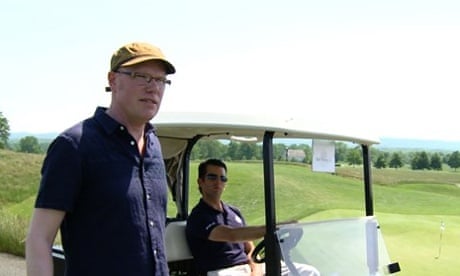
The choices were limited on Friday night, so we opted for this docu-drama, focussed on exposing the ugly arrogant and ignorant Donald Trump trying to bully the locals near Aberdeen, to build a very expensive golf club and resort. This was really the second drama by the British director Anthony Baxter, to follow 'You’ve Been Trumped' which grabbed news headlines back in 2011. It continued the protest against property tycoon Donald Trump’s scheme to bulldoze a luxury golf resort across environmentally sensitive coastline in northeast Scotland. There were quite a few strands to this drama; the corruption of many by money and perceived power; the portrayal of golf as an elite sport for the super rich and the stoic attitude of people who really love the land and their lifestyle in Aberdeen and later Dubrovnick. It was quite disjointed in places and there was a feeling that the film was just another different level of propaganda. There are always more than two sides to every story. But I think the take home message for me was something about the power of bullies to engage people with formal power, such as police and Mayors, to take their side, probably with promises of lots of money! Is it also a coincidence that these people are often over weight and have a very superificial way of thinking and speaking?

Gone girl twists in the tail

The film opens with a scene on their fifth wedding anniversary, where Nick(Ben Affleck) laments that he can not know what his wife Amy(Rosamund Pike) is thinking. It quickly becomes clear that this marriage is all but over, except when he returns home from a fairly honest bar chat with his twin sister, we realise that Amy has gone missing. So the plot moves quickly to find out what has happened and why? Was she kidnapped? Did Nick kill has wife? Did she stage her own murder in revenge for him cheating on her? No one is quite what they seem in this tantalising adaptation of Gillian Flynn’s bestselling marital mystery. The pace quickens and each argument is conveyed very convincingly, until we see a version of the truth that is very confronting... There are questions about who could be a sociopath and at times, it seems both could be.

Friday, August 8, 2014

explosions of colour, shape and texture at the Summer Exhibition

For all it's pretentious elitism, the Royal Academy hosts one of the few truly open art exhibitions; this 246th year they chose more than 1,000 prints and paintings from the over 12,000 submitted. Always there are true masterpieces from the 100+ Royal Academicians and some notable distinguished and foreign Honorary Academicians, like Anselm Keifer and Georg Baselitz. Every room is overflowing and the walls are absolutely covered from floor to ceiling. My first impressions several years ago were similar to the sensory overload of arriving in India. Over the last few years, I have become accustomed to the style of several better known Academicians, such as Sean Scully, Barabara Rae and Tracey Emin. But this year, similar to last, I discovered some new and great talents to watch. My 3 favourites are the bright stylised flowers and fruit of Gillian Ayres, the clean contemporary lines of Michael Craig-Martin and the geometic colours and shapes of Mali Morris. I also love the links between Venice Biennale artists and the uncertainties of knowing who will become truly great in the eyes of the world... And of course, there was an almost hidden masterpiece of film in the final room titled "walking drawings across estuaries" where horses and people make stunning marks in the bare sandy beaches of a northern English estuary.
Wednesday, July 30, 2014

Malevich- from figures to shapes and back again

It is rare to see the transition of a great artist from figures through abstract to defined shapes and back to enhanced figures. Tate Modern has secured a truly international retrospective that is both aesthetically comprehensive and intellectually complete. Kazimir Malevich was born in Kiev in 1879 and seemed to absorb impressionism, surrealism and cubism in order to define his own geometric style, otherwise known as suprematism. He is recognised as an avant garde leader, with his Black Square being a key contribution. His career spanned a politically unstable period in Russia and was obviously influenced by his European contemporaries. Each of the 12 rooms are distinct and dramatically different from the others. It was great to see his commitment to teaching about colour and form, even using German to move beyond Russia. This room reminded me of the Bauhaus movement but was almost 10 years earlier. I loved the way he predicted the death of painting, but then showed us that he could engineer it's own resurrection...