Saturday, December 31, 2016

the underbelly emerges in The Dinner

This book takes the reader along to a popular restaurant in Amsterdam with two brothers and their wives for a summer evening 5 course meal. Paul, the narrator seems like a calm and observant family man, who is somewhat in awe of the publicity his brother is receiving as a future prime ministerial candidate. While there are the usual brotherly spats, what we don't fully realise is the reason for the dinner; a discussion about their 15 year old sons should but does not really happen, and probably would never have been a discussion. We quickly realise there are no polite happy families and the horrific behaviour of both boys may not have just been a coincidence. They were caught on a grainy CCTV camera and are recognisable to both parents - but there are differences of opinion about what to do next. There is also the threat by the older adopted brother to release a youtube video. Throughout the first few courses, we begin to appreciate Paul's sinister and violent underbelly. While the promise of a diagnosis is confusing, it probably does not matter whether he has a personality disorder, Aspergers or is a sociopath. What is important is that there is a genetic link and that medication could be helpful, if taken as prescribed. It is also quite shocking to realise that Paul's wife is fully aware and not only accepts but covers for her husband and son. It seems inevitable that this boy has amazing capacity for violence, which his father is slow to recognise. By the end of the meal, it is clear that decisive action is needed, and violence seems inevitable...

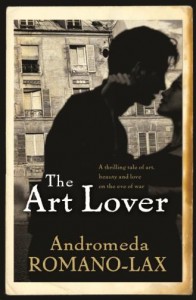
An enjoyable experience, reading The Art Lover

This was a book and an author I have never heard of - but as friends' recommendations goes, it was a good one! The author, Andromeda Romano-Lax has a Greek first name, Italian and German heritage, and she married into a Jewish family. She grew up in Chicago, worked as a travel writer and freelance journalist before becoming a writer and living in Anchorage, Alaska. It seems this book unpacks something about individuals' search for meaning in Europe between the wars. The novel opens in Munich in 1938, where an introspective young German, Ernst Vogler is learning to make sense of the present by understanding Greek and Roman art. He works on the Sonderprojekte, which is a quest by Hitler, to amass European masterpieces, to promote human strength and beauty in natural settings.The book opens with the disappearance to Dachau of his artistic mentor, but he is given a book and a personal story, which match and underpin his work project. He is sent to deliver the classical sculpture "the discuss thrower" from Rome to Germany. This simple plan slowly turns into a dangerous detour of deception, corruption, lies and murder, across the beautiful Italian countryside. Ernst is both naive and unprepared for the situation that evolves, largely involving twin brother drivers being chased by a greedy German diplomat. There is sufficient depth of character of the three young men who share the front seat of the truck while the sculpture is hidden in the back. Gradually, the Italian family life emerges and it is not surprising that Ernst realises a few days in Italy can change his life; the advice given to him by his mentor! The elder sister's story matches his own in strange ways and he learns more about himself as a result. Then it is quite a treat to read forward 10 years to when he is tasked to return the sculpture to Rome and he revisits the Piedmontese hillside where the family lived...

Thursday, December 29, 2016

The Fencer emancipates Estonian children

The Fencer is a Finnish-Estonian-German coproduction based on the true story of Endel Nelis, a championship fencer who worked as a sports teacher in Haapsalu, a small coastal Estonian town. It is important to know that the Soviets occupied Estonia in 1940 and drove out the Nazis; but also persecuted the Estonian men who had been forced to join the German army. Many were executed or sent to Siberia, so the small towns were populated by children without fathers. Estonia only regained its independence in 1991. Back to the film, and just after the war, Nelis (Mart Avandi) arrives as the new sports teacher. The suspicious principal (Hendrik Toompere) remarks that fencing is not a proletarian sport, and therefore not suitable for the children. After his attempt to set up a skiing club is scuppered by the army taking all his equipment, and he is observed by young Marta practicing, he sets up a Saturday fencing club. It is great to see the children and later the parents supporting their development and expressing themselves; they start using branches as foils and only gradually acquire donated equipment. There is a back story that Endel fled Leningrad and he must make a difficult choice as to whether to support his team in the national fencing tournament in Leningrad. There is a real sense of despair and depravation, that is somehow mediated by individual focus and achievement in the structured sport of fencing. We see a few children liberated by their ability to compete, despite a lack of practice and equipment. There is also a desperation mirrored in Endels who is clearly running away but has also learned to love and inspire the children to do their best.

Wednesday, December 28, 2016

Allied: thrills and dangers of life and love

This is a wonderful escapist World War II romantic thriller, produced by Robert Zemeckis. The film opens in Casablanca, with 2 spies played by Brad Pitt and Marion Cotillard. Max, a Canadian wing fighter is introduced to Marianne Beausejour, a French resistance fighter. They are given orders to pretend they are married and there is a dramatic irony in how they behave as if they are in love. Cinematography is excellent, with gorgeous sand dunes contrasted against high class parties. The costumes take us back but in a smart and sassy way. The war is an enduring background, and the common German enemy is ever present. The romantic drama is mirrored against some tricky espionage work, a baby being born in the middle of the London Blitz and then the real twist, where it is difficult to decide who or what to believe. Perhaps it also mirrors some the real life challenges for Brad. Nevertheless, I was mesmerised and ever so thankful to be able to walk out to a normal peacetime life!

Sunday, May 15, 2016

the film Sherpa packs a punch

I made it to the final screening at the Gold Coast Arts Centre, of this Australian docudrama. The film documents the lead up to and events following a massive avalanche in the Khumbu icefall in April 2014. Australian climber and film-maker Jen Peedom was filming in the region, when thirteen of the dead were Sherpas. This natural disaster released an explosion of unresolved tension built up by years of inequality by western commercial climbing companies. From the outset, sherpas were crucial in the success of western summiteers. Edmund Hillary could not have summited without Tenzin Norgay. Yet Tenzin was never given the same respect as Edmund and this pattern has been repeated over the years. The absolute difference in journeys through the extremely dangerous Khumbu icefall says it all; western clients do it twice while the sherpas may cross between 20-30 times a season. It seems that foreigners can pay out the risk so they have the luxuries they need for their climb. Further, the Nepalese government is taking up to 30% of the profits without delivering pensions or support for the sherpa families. The sherpas realised their power and closed the everest climbing season.

Saturday, May 14, 2016

Sydney's 20th art biennale intrigues...

The overall theme says it all... The future is already here - its just not evenly distributed. Then, each site is designated as an embassy with a particular thematic focus. So a section of the Museum of Contemporary Art becomes the Embassy of Translation - and it is here that there are some of the few references to indigenous Australia. I most enjoyed Cockatoo Island, a former convict settlement and shipyard that is being reused for performance and dramatic art. It was designated as Embassy of the Real and there were many unique pieces of 2 and 3 dimensional art displayed within an evocative setting and with amazing views across the harbour to the CBD at key points. For me, the reality was more about using space, history and location to share a message. I was also impressed by the cavernous Carriageworks complex in suburban Redfern; an old train maintenance workshop revived also for drama and art. I was not very convinced by it as an Embassy of Disappearance, because many of the piece were either disjointed or intensely personal and detailed. The Art Gallery of NSW established a dedicated Embassy of Spirits, which while engaging did not inspire or connect with me. The final venue I visited was Artspace in Woolloomooloo, an large open warehouse, transformed as the Embassy of Non-participation. Maybe I tried to see too many places in one long weekend, but there was a recurring theme; many pieces were intricately planned, often influenced by asian cultures and required a lot of time and assistance for engagement. Maybe that is more of a reflection of where Australian art is heading...

Grayson Perry's pretty little art career in Sydney

I have struggled to recognise Grayson Perry as an important British artist and art commentator. I have perceived his attempts to shock as somewhat ironic given his traditional use of the more conservative forms of pottery. More recently, I have been slowly and steadily rethinking my perceptions of this artist. The recent comprehensive exhibition of his work from the early 80's to the present at the Museum of Contemporary Art in Sydney certainly helped. I like the way exhibitions of contemporary artists often include informative and explanatory videos of and by the artists.
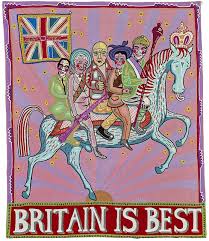
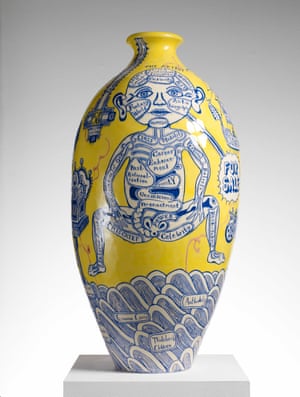
On this occasion, I enjoyed seeing the repetitive and highly skilled craftsmanship of creating and illustrating the giant pots that Grayson has made a hallmark of his career. I realise that he has actually worked to individually create each pot as his 3d canvas for his creative messages, which are themselves composed of multiple scenes and images. Often the connection is evident, but there are times when it eluded me - and then I could admire the detailed drawing or collage. I also enjoyed his 2d drawings, especially his copies of mandalas, mind maps and large story boards. Hidden throughout the exhibition were a rage of small and large sculptures which were also intriguing. I really was totally impressed by his full wall tapestries - even though he has them mechanically made, which is yet another ironic twist! But overall, I can see a man who intellectually knows and respects traditions, to a point, and then he bombards us with words, images and connections which challenge the way we view his images. So his rebel message is often more intellectually crafted than is first apparent. However, it is very English and in that way, is somewhat globally naive. I think the more I see his work and understand his preoccupations with sexual and class identity the better I can read each piece.